
Friday, April 22, 2016
June Baker To Graduate In January 1944

Lime Kilns
When the first colonist came to Delmarva there was
a lack of mortar to build with.
Fireplaces and the chinks between logs and board walls were filled with
mud. This was short term, however, as
when the next rain came it would wash out the mud. What was needed was lime to created cement,
plaster, whitewash, etc. With no natural
stone and certainly no limestone available on Delmarva the Colonist turned to
oyster shells and other sea shells.
Exposed to high heat the calcium carbonate in the
shells would make calcium oxide or “quicklime”.
This was slaked in water prior to use in mortar and plaster.
Stacks of logs were put on ground or in a pit and
shells were stacked on top of the logs.
This created a lime rick. The
fire had to reach 1800 degrees and the burn would last for about 24 to 36
hours.

It was very hot work and considering the caustic
effect of lime on human skin it made for very unpleasant work. The long term effect on one's lung most have been horrible.
The finished lime from the ricks were hauled to
where the construction required it.
At first the lime ricks were placed near the
Indian middens of shells (those massive piles of discarded shells bones and
other detritus built up over hundreds of years by local Indians ) and they
continued to be placed near the source of the shells as the oyster industry
took off. Seaford had a large lime kiln. The map of Fairmount shows they also had a
lime kiln. It was located over by the ice house and packing sheds.

When the railroad line to Crisfield was built it
changed things. Crisfield with its huge
piles of discarded oyster shells supplied many oyster kilns that were placed
near to the rail lines such as the one in Fruitland in the 1920s.
While all lime used for building purposes had to be
thoroughly burned, it was not crucial for mortar lime to be pure, and it
was commonly known as “lean lime”. However plaster lime was known as “fat lime”
which required a higher calcium content.
Thus partially burned shells may be present in shell lime mortar but
seldom will be found in shell lime plaster.
Because burned lime absorbs water over time, it is
considered as a perishable product that must be used in a set period of time or
it becomes useless for construction purposes. By adding sand to the lime the bonding between
the sand and lime creates a hardened product (mortar or cement).
Lime kilns went from being the simple lime rick to
lime kilns where a tower with an inverted cone shape inside the tower and a
firebox at the bottom would generated more lime than the simple rick.
Altho there were a number of Lime Kilns on the
Eastern Shore about the only remains of them are in the name of roads or
geographic points.

Above notice from the Salisbury advertiser 1888
Wednesday, April 20, 2016
The Mid Life Crisis Of M. H. German
Mitchell H. German was born in what was to become Delmar, Sussex County Delaware about 1851. He was the son of George W. German (1827-1888) and Matilda J. Hastings German (1827-1863). He would marry in 1873 to Francis Ann Hearn, born in 1849, and daughter of Jonathan Hearn of Harford County. They would live on the Maryland side of town or on their farm outside of town in Wicomico County.
They would have as children; Marion H. (1873-1898), Rosa B. (1874-), Matilda Ellen (1876- ), Sadie E. (1878-), Harry L. (1881- ), Loren Halbert (1884- ) and Roberta B. (1889-).
Mr. German was an entrepreneur type and was active in the social life of Delmar. He started a number of businesses from a brick plant to a Dry Goods Store to a drug store. He built what is referred to as Brick Row (Seven brick homes city row style along the rail road tracks). He was a director of the Bank of Delmar and a leader of the choir of the Methodist Protestant Church.
In August of 1901, he got on the train to travel to Aberdeen, MD with the ideal of locating a piece of land to put a brick yard on. He was not heard from again until December. No one knew what had happened to him. They did know he was carrying a large amount of cash on his person ($16,000) with which to set up the brickyard. There was much speculation as to what happened to him. A person from Delmar had seen him meet a Mrs. Frank Harmonson at the Philadelphia train station and it was known in Delmar he had a special relationship with her when she was the housekeeper for W. L. Sirman in Delmar. He did have a history also of being very attentive to a Mrs. Lecates in Delmar. Speculation was he had run off with Mrs. Harmonson, as he was 50 year olds and men sometime did those things at that age. Investigation found he had heavily mortgaged all his properties and taken out loans from various people before leaving.
Mrs. German did what any self respecting wife would do; she filed for a divorce.

His disappearance was of interest to the newspapers and various reports were written on it. A fire destroyed part of Delmar in September and, no pun intended, took the newspaper heat off of Mr. and Mrs. German's problems.
In December of 1901 Mr. German had decided he had enough. He had traveled to Liverpool, England as he put it; trying to put as many miles between him and his creditors, but he was not that kind of man and returned to Delmar to make his amends. There was no mention of Mrs. Harmonson. Mrs. German dropped the divorce action. They continued to live on their farm outside of Delmar. Up until 1901 there were many land transfers as Mr. German bought up land, after 1901 there were many land transfers as Mr. German sold off property.
Mitchell H. German would die in 1915 and would be buried in Delmar. His wife would go to live in Norfolk with Loren, her son and his family. She would die in 1925
Tuesday, April 19, 2016
The Surname German or Jarman
Around Delmar there are families with the Surname German. In researching some of these families (not all) I find at some point (around 1850) the name would be written as Jarman or Jerman. It seems to a common feature of the surname everywhere in the USA. It could be because of the cursive handwriting of the time in which the letter "J" and the letter "G" look alike. An interesting comment is below from a surname website.
JARMAN: This interesting surname is English. It is however of pre 9th century Old French origin, and has two possible interpretations. Firstly, it may be an ethnic name derived from the term "germain", itself from the Roman (Latin) word "germanus". As such the name was sometimes used to denote a man from Germany, but was also used in the case of a person who had trade or other connections with the country. The ultimate origin of the Latin tribal name "Germanus" is obscure, but it is thought to mean the "spear-men", with "geri, gari", meaning spear, as the first element. The second possible derivation for the surname is from the Old French and later medieval English given name "Germa(i)n", which itself derives partly from the tribal name as before, and partly from the Latin and Old French "germa(i)n", meaning "full brother, cousin". This is originally from the Latin "germen", literally a bud or shoot, and used to mean "of the same stock". The given name is recorded in the Domesday Book of 1086 as "Germanus", and Jerman Willelmi is listed in the Feet of Fines for the county of Essex in 1248. The surname spellings include German, Germaine, Germing, Jarman, Jerman, Jermyn and Jarmain. The first recorded spelling of the family name is shown to be that of John Jarman. This was dated 1227, in the "Patent Rolls of Norfolk", during the reign of King Henry 111rd of England, 1216 - 1272. Surnames became necessary when governments introduced personal taxation. In England this was sometimes known as the Poll Tax. Throughout the centuries, surnames
JARMAN: This interesting surname is English. It is however of pre 9th century Old French origin, and has two possible interpretations. Firstly, it may be an ethnic name derived from the term "germain", itself from the Roman (Latin) word "germanus". As such the name was sometimes used to denote a man from Germany, but was also used in the case of a person who had trade or other connections with the country. The ultimate origin of the Latin tribal name "Germanus" is obscure, but it is thought to mean the "spear-men", with "geri, gari", meaning spear, as the first element. The second possible derivation for the surname is from the Old French and later medieval English given name "Germa(i)n", which itself derives partly from the tribal name as before, and partly from the Latin and Old French "germa(i)n", meaning "full brother, cousin". This is originally from the Latin "germen", literally a bud or shoot, and used to mean "of the same stock". The given name is recorded in the Domesday Book of 1086 as "Germanus", and Jerman Willelmi is listed in the Feet of Fines for the county of Essex in 1248. The surname spellings include German, Germaine, Germing, Jarman, Jerman, Jermyn and Jarmain. The first recorded spelling of the family name is shown to be that of John Jarman. This was dated 1227, in the "Patent Rolls of Norfolk", during the reign of King Henry 111rd of England, 1216 - 1272. Surnames became necessary when governments introduced personal taxation. In England this was sometimes known as the Poll Tax. Throughout the centuries, surnames
in every country have continued to
"develop" often leading to astonishing variants of the original
spelling.
Read more: http://www.surnamedb.com/Surname/Jarman#ixzz46EjoY3UP
Read more: http://www.surnamedb.com/Surname/german#ixzz46H7McRed
Read more: http://www.surnamedb.com/Surname/Jarman#ixzz46EjoY3UP
Last name: German
Recorded in many spelling forms including German, Germann, Germain, Germing, Jerman, Jarman, Jarmain, Jarmains, Jermyn etc.(England & Ireland), Gherman (Hungarian), Germani (Italian), Germain (France), Germano (Spanish) and De Germano (Sicilian), this surname can be of either nationalistic, locational, or job descriptive origins. Firstly it can obviously mean a 'man from Germany'. Such names were given when a person moved from one country to another. The easiest method of identifying a 'stranger' being to call him or sometimes her, by the name of the place from whence they came. Spelling being at best erratic and dialects very thick, lead to 'sounds like' spellings of the name. For many nameholders in England the name is probably not Germanic at all, but locational and Norman-French. The entry into England dates from about the time of the 1066 Invasion, and it probably describes a person from the town of St Germain in Normandy, France. Taking the French connection further, the name can also be one of relationship, and derive from the pre 8th century Old French word "germain", meaning cousin or person of the same stock. Another possible origin is that people with the name were originally 'spear-men' engaged as mercenaries by different monarchs throughout Europe. The derivation here being from the German word "geri" meaning spear plus "man(n)", meaning one skilled in its use. The first recorded spelling of the family name is believed to be that of William Jermain. This was dated 1279, in the "Hundred Rolls" of the county of Oxfordshire". Throughout the centuries, surnames in every country have continued to "develop", often leading to astonishing variants of the original spelling.Read more: http://www.surnamedb.com/Surname/german#ixzz46H7McRed
Monday, April 18, 2016
1920 Auction Ad Of Brick Row

It describes the houses as six of them having 6 rooms each, 2 porches, pantry, 2 halls, bathroom, city water and gas for lighting and cooking.
The 7th house had ten rooms and had been the residence of Mitchell H. German when he built it.
The property in 1920 was owned by Mr. Jay Williams. At the auction J. Frank Brown purchased it.
Sunday, April 17, 2016

Monday, April 11, 2016
Some 1942 graduates from Wi Hi That were born In Delmar
From The 1942 Tom Tom Yearbook Wicomico High School Salisbury MD
Some People who gave Delmar as their birth town
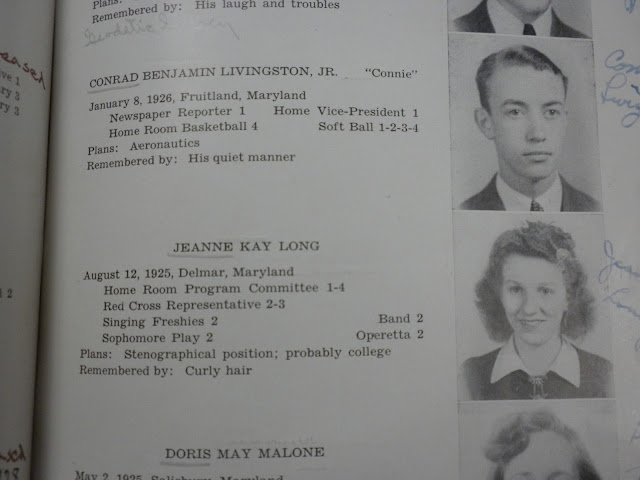 Jeanne Kay Long born August 12, 1925

Flossie Lee Spry, Born July 3 1924
 Joseph Franklin Callaway Jr, Born September 11, 1925
 Alyce Anne Kennedy, born July 1, 1924

Evelyn Marie Owens, born June 22, 1924

Anna Virginia Donoway, born October 2, 1925
Some People who gave Delmar as their birth town


Flossie Lee Spry, Born July 3 1924


Evelyn Marie Owens, born June 22, 1924

Anna Virginia Donoway, born October 2, 1925
Subscribe to:
Posts (Atom)