Thursday, June 21, 2018

1952 Rat Invasion

From the Bi-State Weekly August 22, 1952

DELMAR IS BEING INVADED BY RATS

The citizens on the West side of Delmar have been complaining of being invaded by rats. The big ones are getting bolder and have been detected on the East side of the tracks by at least one merchant.

It all goes back to the brickhole as a public dumping area. As long as trash and rubbish was hauled into the hole daily, the rats were well fed and stayed in their own environment. Recently the owner discontinued dumping in the "hole" because it wasn't being used properly. On top of this a fire burned there several days and wiped out the rats food supply.

Now the varmints after being on a starvation diet, are out searching for food. Thorpe Caldwell, a store keeper in the area, says that they have eaten his garden up. He goes on, "..they eat my tomatoes, plants and all". The pods on his beans have been eaten off. Mr. Caldwell is staging a one man war on them now.

The question in the mind of many is, Who Is Responsible? The owner donated the spot to the town. everyone used it either directly or indirectly. It is outside the city limits so the town cannot act, we are told. The State Board of Health says it has no jurisdiction.

The Delmar Maryland Bailiff

Prior to having a policeman or police force, Delmar Maryland had a position known as Bailiff. In the Town Charter are a number of standard clauses about what the town can do. Usually protect and safeguard the citizens was one. Also however was maintain the streets. The Bailiff position started out as safeguarding the citizens but by the 1900's the duty of Public works or Street Commissioner was also added. In addition he collected Town taxes. This was before government and civilian positions became specialized and everyone was expected to do what ever was required to make the town work.

On June 12th 1912 Mr. William B. Elliott was appointed the town Bailiff. He replaced Mr. Daniel H. O'Neal as bailiff. Because the bailiff collected taxes he had to post a $100 bond.

"Now the conditions of the above bond are such that the said William B. Elliott shall faithfully perform the duties of Bailliff of the Town of Delmar, Maryland, and shall pay over all mony coming into his hands, and perform all acts and duties of said office, then this bond shall be void, other wise, to remain in full force and virtue of law.
Witness our hands and seals, this 28th day of June 1912."


Bailiff Elliott, who was about 62 years of age in 1912, was paid a percentage of the taxes he collected. This percentage appears to have been in the 15% to 20% range.

His job as law enforcer in Delmar was to keep the peace and enforce ordinances. I did not see a reference to the pay he received for this but other bailiffs in the area would receive a percentage of the fine imposed by the Justice of the Peace(about half of the fine) and a bounty of about 30 cents on each person picked up. From the Delmar Maryland Council minutes we see he was ordered on May 11, 1914 to break up ball playing on the streets of Delmar, Md. He was also in the same meeting told to notify Chas Sturgis to take out a town license or abide by the law. In February 2, 1914 the council ordered him to prevent skating on the street of Delmar, Maryland. Extra assistant bailiffs were hired for his absences and on February 2, 1914 Thomas C. Knotts was appointed to act as backup bailiff.

His pay was broken down into the type of job he was doing at the time, thusly his police duty was paid separate, his tax collecting was paid separate and his street commissioner job was paid separate.

In 1912 when he was appointed bailiff the council paid him 15 cents an hour plus 10 cents more if he used his horse, showing that the labor of a man was worth 50% more than the labor of a horse. This pay seems to have been related to the work on the streets he had to do. Part of his street work consisted of rounding up men to work on the streets. As readers of this blog know from a previous post in 1912 all men between 21 to 50 living in Delmar were required to work one day a year to maintain the streets. In addition I am of the impression he hauled the cinders and shells around the town patching pot holes in the street. In 1913 he was paid $451 dollars for street work.

William B. Elliott had the Elliott Brickworks located on the west side of Delmar.

1917 Sanitation Items In Delmar Maryland

Some highlights of the Delmar, Maryland Council meeting minutes in 1917 regarding sanitation. It would not be until 1927 that Delmar had a sewage treatment plant and a sewage collection system. Until that time outhouses and septic systems were on each property in town.

Oct. 8, 1917
Motion made by W. S. Parker; 2nded by R. R. Walls that Levin Hastings be notified to take care of his waste water where Mrs. Knotts occupies his property within ten days as it is a nuisance and a menace to health.

Motion made by G. L. Long, 2nded by R. R. Walls that Mrs Knotts be notified to clean out her hog pen within ten days and keep the same in good clean condition.

Sept 6, 1917
Bailiff was instructed to put lights on East State and E. Elizabeth Streets; also to notify Hearn and Venables, S. H. Whayland to clean up premises of all rubbish also to clean out toilets on the rear of their lots. He was also instructed to notify Mrs. L. A. Truitt to have the weeds cut on her lot.

May 9, 1917
Bailiff was instructed to notify Mrs. Annie Parker to have her cesspool looked after as the odor was very annoying to the citizens near her. Moved and seconded that May 24 be the day designated as clean up day for the rubbish on the Delmar, Md. side of town.

Wednesday, June 20, 2018

The Ashpit


1918

Above is a well known 1918 postcard of the Delmar Railroad Yard. Locomotives, when they came into Delmar, were pulled off the main line for a quick service.  In about two hours fires were shaken down and ashpans cleaned out, and fresh fires started.  Then there was oiling, cleaning the engines, polishing the bell on the engine, tightening up, filling the big domes behind the smoke stack with sand (sanding- the big dome is on top of the engine to keep the sand dry) and inspection then the tender is filled with about 18 tons of coal for a run in either direction.   In the center of the postcard is the ashpit.

Closeup of ash pit in postcard

Above is the ashpit in Delmar, just a hole in ground with tracks over top of it.  As coal is shoveled into the fire box

The coal lies on top of a grate and burns.  The ash falls though the grate to an ash pan.  The ashpan could hold about 2,000 pounds of ash.   Sometime the coal being used had a large amount of impurities in it, such as metal ore and that would melt and form with other melted impurities creating large clinkers.  Those clinkers would have to pulled off the grate when the ashpan was dumped into the ashpit.  So the locomotive would pull over top of the ashpit and ashpan would be dropped so the ash went to the ashpit. 

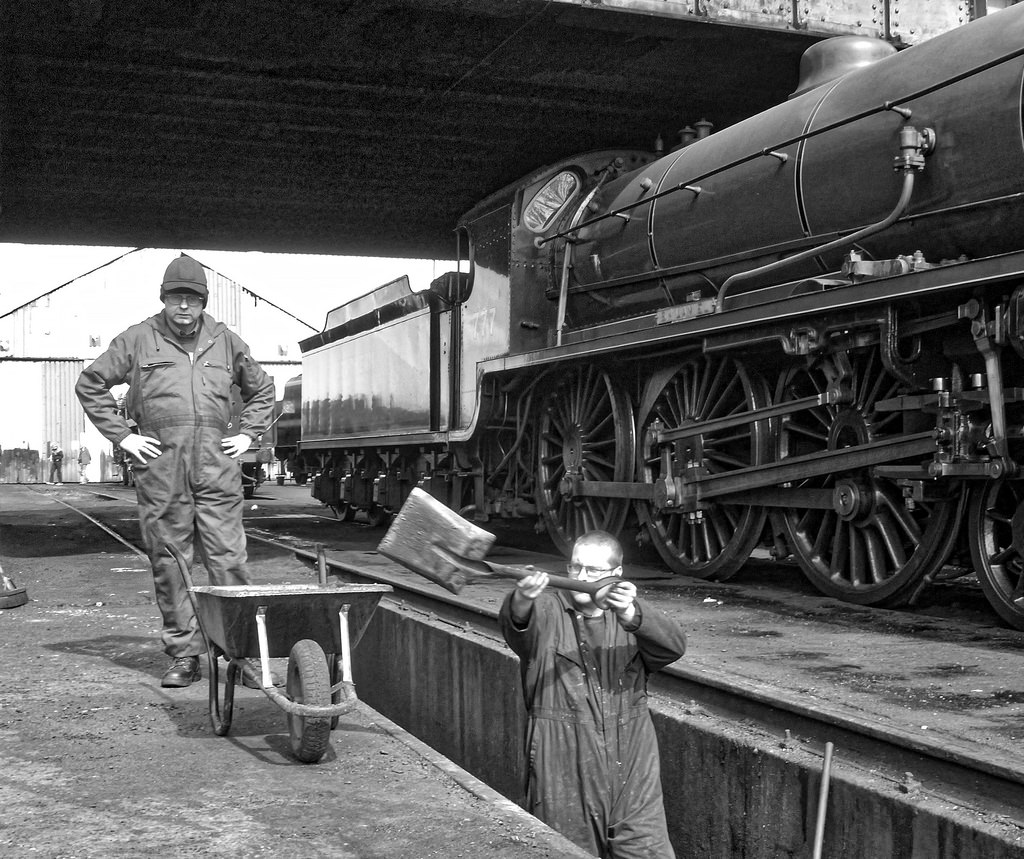
The locomotive would then powerwash off for the remaing ash that didn’t fall into the pit. The above photo is not Delmar

The ashpit would have to cleaned out by railroad laborers and the ash used as ballast under new rail track or sold off as construction material. Again photo below is not Delmar

Since the ashpit was an open hole there was a certain danger working around it.  The workers would usually be paying attention to the train they were working on and not where they were walking.  On occasion they would fall into the pit.  Since the ash was usually still hot from the engine there was danger of having severe burns. Oddly enough there was also the danger of drowning since the pit would fill with water in heavy rains.

1912 View of Delmar Rail Road Yards

Harry L. Purnell (half of Truitt and Purnell postcard publisher) died in 1912 from Typhoid fever at the age of 26.  He was a druggist and the son of William Quinton Purnell and Mary Martha Layton Purnell.

So what was the photographer on to get a birdseye view of the yard?

Whayland Groceries abt 1930

Howard Tinley, W W Whayland, Leon Mills, and Matthew Whayland.

1950's PRR Ad